

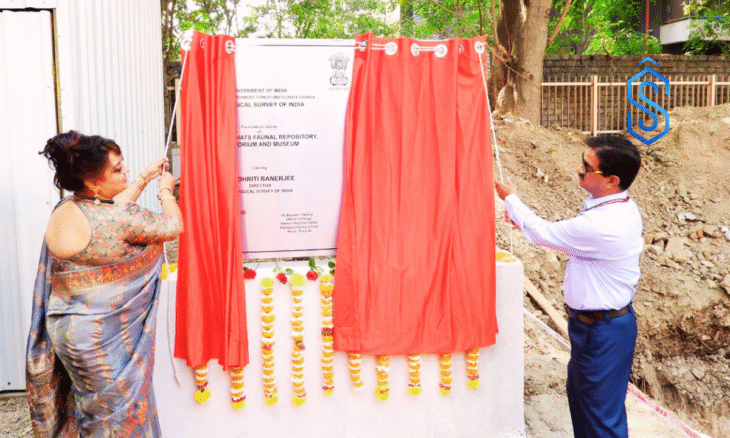
Pune: The foundation stone for the Western Ghats Faunal Repository and Auditorium was laid at the Western Regional Centre of the Zoological Survey of India (ZSI) in Pune, marking a significant milestone in strengthening biodiversity research infrastructure in the country.
The ceremony was led by Dr Dhriti Banerjee, Director, ZSI, who formally initiated the development of the Western Ghats Faunal Repository and Auditorium as a dedicated faunal diversity hub in the region.
The upcoming Western Ghats Faunal Repository and Auditorium will serve as a state-of-the-art scientific infrastructure focused on the documentation, conservation, and study of the rich and unique biodiversity of the Western Ghats, one of the world’s globally recognized biodiversity hotspots.
Western Ghats Faunal Repository and Auditorium: Preserving Invaluable Animal Specimens
The Western Ghats Faunal Repository and Auditorium is being constructed to safely preserve lakhs of invaluable animal specimens collected from across the Western Ghats region.
The facility will house representative specimens from diverse faunal groups, including insects, molluscs, fishes, amphibians, reptiles, birds, and mammals.
“It is to be designed with modern preservation facilities, the repository will ensure long-term conservation of original specimens, which serve as the backbone for taxonomy and systematic research,” said Dr Dhriti Banerjee, Director, ZSI.
She further added that the infrastructure is being planned to evolve into a faunal diversity hub for students aspiring to pursue education and careers in faunal diversity-related studies.
The Western Ghats Faunal Repository and Auditorium is expected to provide advanced preservation systems to maintain specimen integrity for scientific study and reference.
Also Read: Cities of Care Conference Highlights Research-to-Policy Pathways for Climate-Resilient Indian Cities
Scientific and Educational Significance
The Western Ghats Faunal Repository and Auditorium is expected to deliver wide-ranging scientific and educational benefits. The facility will:
- Provide a strong foundation for taxonomic and systematic research.
- Serve as a reference centre for biodiversity assessments and conservation policy formulation.
- Facilitate scientific documentation of rare, endemic, and threatened species.
- Develop a comprehensive digital database to ensure global accessibility of faunal information.
- Offer educational and exhibition facilities for students, researchers, and the general public.
- Promote science communication, awareness, and biodiversity conservation through curated museum specimens.
The Western Ghats, recognized globally as a biodiversity hotspot, are home to numerous endemic and threatened species.
Highlighting the importance of the new facility, Dr Basudev Tripathy, Scientist-E and Officer-in-Charge, ZSI, Western Regional Centre, Pune, stated, “This faunal repository will significantly strengthen national biodiversity documentation programmes and provide robust scientific evidence for conservation planning.”
In addition to research and education, the Western Ghats Faunal Repository and Auditorium will function as a Wildlife Forensic Support Facility.
It will offer identification and advisory services on confiscated wildlife animals and related materials, thereby supporting wildlife law enforcement and conservation actions.
The centre will assist enforcement agencies such as the Maharashtra Police, Forest Department, and Customs Department.
Also Read: SusMafia Secures ₹2 Crore CSR Grant from Zerodha to Scale Climate Education and Startups
By integrating research, conservation, education, and forensic expertise under one roof, the Western Ghats Faunal Repository and Auditorium is set to significantly enhance India’s biodiversity documentation and conservation ecosystem.
With this initiative, Pune is positioned to emerge as a leading centre for faunal diversity research and scientific excellence, reinforcing the nation’s commitment to protecting its natural heritage for future generations.